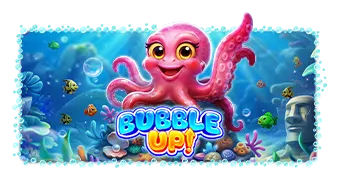
Bubble Up!
Bubble Up! is an aquatic Pragmatic Play slot where 2×2–6×6 bubble frames collect money symbols, and overlapping frames can boost their values by up to 10x.
Play Demo Play for money

Pragmatic Play pirate and sea slots with ships, treasure, krakens, underwater worlds and sea creatures, from classic adventures to Bubble Up!.
Bubble Up! is an aquatic Pragmatic Play slot where 2×2–6×6 bubble frames collect money symbols, and overlapping frames can boost their values by up to 10x.
Play Demo Play for moneyThe ocean's depths come alive once again in the thrilling sequel, Release the Kraken Megaways™, from the renowned game developer Pragmatic Play. Building on the success of its predecessor, this latest installment takes players on an underwater adventure filled with excitement, mystery, and ample opportunities to win big.
Play Demo Play for moneyCaptain Kraken Megaways by Pragmatic Play Set sail in a nautical adventure with Captain Kraken Megaways, a 6×7 Megaways slot offering up to 200,704 ways to win. The sea-themed game feature...
Play Demo Play for moneyGet ready to reel in some big wins with the exciting slot game, Lobster Bob’s Sea Food and Win It, where the culinary king of crustaceans makes a triumphant return! This sequel, featuring a 5x3 grid, invites players back to Lobster Bob's bustling seafood shop, where thrilling features and delectable rewards await.
Play Demo Play for moneyAhoy there, fellow adventurers! Get ready to embark on a thrilling journey across the seven seas with the exciting slot game, Pirates Pub™ by Pragmatic Play. This swashbuckling adventure promises not only a captivating storyline but also an array of treasures waiting to be claimed.
Play Demo Play for moneyGet ready to plunge back into the depths of the ocean with Release the Kraken® 2, the highly anticipated sequel from Pragmatic Play. This game invites players to explore the mysteries of the sea, featuring a familiar 5×4 reel setup that fans have come to love. Packed with exciting features and potential rewards, this slot promises an exhilarating underwater adventure.
Play Demo Play for moneySet sail for adventure and treasure with Pirate Golden Age™, an exhilarating slot game from Pragmatic Play that immerses players in a world of swashbuckling pirates and hidden riches. This 5-reel, 3-row video slot features an array of symbols that transport players back to the golden age of piracy, where daring buccaneers and menacing skulls help create winning combinations across 20 paylines.
Play Demo Play for moneyAre you ready to embark on a thrilling adventure filled with riches and treasures? Star Pirates Code™ is the exciting new video slot from Pragmatic Play that invites players to navigate the high seas aboard a ghost ship, where hidden rewards await at every turn. This captivating 3 × 5 slot is designed to keep you on the edge of your seat as you uncover the secrets of the pirate world.
Play Demo Play for moneySet sail for an exhilarating adventure on the high seas with Pirate Gold Deluxe™, a thrilling video slot from Pragmatic Play that invites players to embark on a quest for the legendary pirate treasure. This captivating game features a 4 × 5 reel setup and offers an impressive 40 paylines, ensuring that every spin brings the potential for fortune and excitement.
Play Demo Play for moneyPrepare to embark on an underwater adventure like no other with Pragmatic Play's sensational video slot, Release the Kraken®. This captivating 4x5 slot features 20 paylines and invites players to explore the mysteries of the ocean, uncovering treasures that lie beneath the waves. With its stunning graphics, immersive sound effects, and engaging gameplay, Release the Kraken promises an exhilarating gaming experience.
Play Demo Play for moneyEmbark on a Treasure Hunt with Pragmatic Play's Pirate Gold™ Slot
Play Demo Play for moneyBubble Up! begins with a light aquatic premise, but its defining idea is more precise than a collection of cheerful sea creatures. The game places square bubble frames over random parts of the grid and turns the symbols caught inside them into the focus of each event. A frame can begin as a compact 2×2 area or spread as far as 6×6, so the same feature ranges from a small pocket of opportunity to something that can dominate the screen. This gives the slot an immediately readable visual language: bubbles are not just background decoration, but boundaries that tell the player where the important action is happening. The playful underwater setting keeps the mood buoyant, while the growing geometry gives ordinary spins a useful element of surprise.
Matching three to six sea-creature symbols produces instant wins, keeping the basic action straightforward. Money symbols add a second layer because those included in winning combinations can carry values of up to 10,000x. Bubble Up! does not make the central concept difficult to recognise: familiar aquatic icons provide the regular outcomes, while money symbols are the pieces that become especially important whenever a frame appears. That division helps the game avoid visual confusion. The sea life supplies colour and movement, pearl scatters point towards the bonus, and the numbered money symbols create an obvious source of anticipation. Even before the free spins begin, the game teaches the player to look at the relationship between a money value and the bubble area surrounding it.
During both the base game and the bonus, frames measuring from 2×2 to 6×6 can appear across random grid positions. Any money symbol inside a frame is awarded. The more interesting interaction occurs when two frames overlap: money symbols caught in the shared space receive a boost of up to 10x before their value is paid. This turns placement into the heart of the feature. A large frame covers more territory, but two well-positioned smaller areas can create a valuable intersection. The screen therefore encourages a quick visual calculation without becoming a dry puzzle. It is easy to see the rectangles and their common area, yet there is still suspense in whether the relevant money symbols will sit inside that overlap.
The frame system works because its result is visible before the final amount is settled. One outline establishes a target zone; a second can cut across it and suddenly make the shared cells more important than the rest of the grid. That small shift gives Bubble Up! a distinctive rhythm. Instead of waiting only for a rare named symbol, the player watches the shape of the active area and the values contained inside it. The underwater theme softens what is essentially a positional multiplier mechanic. Rectangles expand like rising bubbles, while money symbols trapped within them become the point of attention. The idea remains concrete enough to follow at a glance, but the possible jump created by an overlap gives it more personality than a standard collect-and-pay event.
The same system also defines the limitation of the base game. Frames appear at random positions, and their value depends on where money symbols land in relation to them. A broad 6×6 frame naturally covers more of the field than a 2×2 frame, but size alone does not guarantee an exciting result. The feature still needs useful symbols in the correct cells, and the strongest boost requires overlapping areas. Players who prefer a meter that rises steadily on every spin may find this positional dependence less predictable. The advantage is that Bubble Up! does not pretend its frames are automatically valuable. The tension comes from seeing a promising outline, then discovering whether it has actually enclosed anything worth collecting.
Landing three to six pearl scatters triggers the bonus game. Every version begins with six free spins, while the number of triggering scatters determines how many modifiers are available, from one to four. Before the round starts, players select coins to reveal those modifiers. The possible effects add more money symbols, add more scatters, increase the initial frame size or guarantee that two frames appear on every spin. This selection stage gives the bonus a small sense of discovery without asking the player to master a new game. Each modifier directly strengthens one part of the existing system: the quantity of valuable symbols, the chance to extend the round, the area covered by bubbles or the likelihood of creating an overlap.
Six free spins is a deliberately compact starting allowance, so the quality of the revealed modifiers matters. More money symbols improve the material that frames can capture. Additional scatters support the extension mechanic. Larger starting frames cover more territory immediately, while two guaranteed frames on every spin create repeated chances for boosted intersections. The modifiers can complement one another, which is where the choice sequence becomes more than a decorative reveal. A round with extra scatters and larger frames develops differently from one built around more money symbols and guaranteed double frames. The bonus remains easy to understand because every improvement feeds the same core idea, yet the opening reveal gives each activation its own emphasis.
Frames appear on every free spin, giving the bonus a stronger sense of continuity than the base game. For every three scatters that land during the feature, two additional free spins are awarded and the frames expand by one level, up to a maximum size of 6×6. This rule connects duration and strength in a satisfying way. Scatters do not merely keep the round alive; they also increase how much of the grid future frames can cover. A successful extension therefore changes the quality of the spins that follow. The progression is visible, easy to remember and appropriately tied to the underwater imagery: the bubbles become larger as the bonus gathers momentum.
There is still no automatic climb to the maximum size. The round begins with only six spins, and every expansion requires another group of three scatters. Some bonuses will therefore end before the frames have grown far, even when their initial modifiers look promising. This is the game’s honest point of friction. Bubble Up! shows the route towards a screen-filling 6×6 area but makes that route dependent on repeated scatter appearances. Players who enjoy bonuses that develop through visible stages are likely to appreciate the escalation. Those who want a fully powered feature from its first spin may find the opening allowance restrained.
Bubble Up! succeeds by giving its aquatic theme a practical role. Sea creatures make the regular matches approachable, pearls open the bonus, and bubble frames organise the money-symbol action into clear zones. The most enjoyable moments come when two frames overlap around worthwhile values, because the screen itself shows why the result has become more important. Free spins deepen the same idea through revealed modifiers, guaranteed frames, scatter extensions and progressive growth towards 6×6. The game is dependent on placement, and a short bonus can finish before its bubbles reach their largest form, so it will not suit everyone who prefers steady accumulation. For players drawn to bright presentation, visible progression and one feature that keeps finding new uses, Bubble Up! offers more substance than its playful surface initially suggests.
Inca Queen: 96.55% highest/default RTP, up to 5,000x, 5×3 format. Coins up to 250x and fiery frames can randomly start Coin Respins, Frame Respins, or a combined sequence. Reaching six relevant symbols leads to Money Respins; a combined trigger may also apply a multiplier up to 10x to collected coin values.
Play Demo Play for moneyHaunted Crypt: 96.51% highest/default RTP, up to 10,000x, 5×3 format. The 5×3 slot offers Value and Speed base modes, with Speed increasing the Free Spins chance. Base-game Wilds can carry up to 10x, and three scatters award ten free spins with five-spin retriggers.
Play Demo Play for moneyTreasures of Osiris — Pragmatic Play Join the Egyptian god Osiris in this mythological slot set on a 5×4 grid where ancient Egyptian symbols, wilds, money and jackpot symbols shape the act...
Play Demo Play for moneyPragmatic Play — Club Tropicana: Happy Hour Club Tropicana — Happy Hour brings a vibrant party/tropical theme with upbeat visuals and festive sound. This slot focuses on a bonus-driven exp...
Play Demo Play for moneyCaishen’s Cash Pots: 96.49% highest/default RTP, up to 10,000x, 5×3 format. Money symbols up to 500x land on reels 1–4 and a Collect symbol on reel 5 pays their sum in the base game. Phoenix, dragon, and tiger scatters fill separate pots and can randomly trigger six free spins with their associated position…
Play Demo Play for moneyBig Bass Splash 1000 by Pragmatic Play Take to the lake in this fishing-themed sequel where 3–5 scatters trigger 10–20 free spins. A fishing animation before the bonus can unlock up to fiv...
Play Demo Play for moneyTriple Pot Diamond: 96.57% highest/default RTP, up to 10,000x, 5×3 format. Money symbols up to 500x land on reels 1–4 and pay when Collect appears on reel 5. Phoenix, dragon, and tiger coins fill their pots and can randomly trigger six free spins with one, two, or three active modifiers.
Play Demo Play for moneyBig Bass Blast combines Fisherman wilds on reels 1 and 5, fish values up to 500x, 5–9 free spins, and five extra spins for every seventh wild as the bonus multiplier rises from 2x to 3x and 10x.
Play Demo Play for moneyBig Bass Trophy Catch: 96.50% highest/default RTP, up to 5,000x, 5×3 format. Three to five scatters award 10–20 free spins. Fisherman Wilds collect every visible fish money value, which can reach 5,000x, and each fourth Fisherman adds ten spins while raising the collection multiplier through 2x, 3x, and 10x stages.
Play Demo Play for moneyGreat Ghosts!: 96.50% highest/default RTP, up to 40,000x, 5×4 format. Blue, pink, and green scatters can trigger Ghost Respins with one or more modifiers. The round begins with three respins; yellow money symbols up to 1,250x stick and reset the counter, while collections of 8, 12, 16, and 20 symbols unlock four…
Play Demo Play for moneyStep into a vibrant world of treats with Sweet Bonanza 1000, an exciting slot game from the renowned developer Pragmatic Play. This enchanting 5x5 slot invites players to embark on a delightful journey through a candy-filled wonderland, where colorful fruit icons, including luscious melons and juicy grapes, along with sparkling heart symbols, can pay out anywhere on the screen. Get ready to satisfy your sweet tooth and experience the thrill of the game!
Play Demo Play for moneyThe Dog House® Slot by Pragmatic Play: A Playful Adventure with Big Wins
Play Demo Play for moneyIf you have a sweet tooth and a love for online gaming, then Sweet Bonanza® by Pragmatic Play is the perfect match for you. This vibrant video slot, featuring a 6x5 grid, invites players into a whimsical world filled with delightful candies and fruity treasures. With its engaging gameplay and exciting features, Sweet Bonanza® promises an immersive gaming experience that can lead to substantial rewards.
Play Demo Play for moneyDive into the delightful world of Fruit Party™, a vibrant video slot game developed by Pragmatic Play that promises an exhilarating gaming experience. With its 7x7 grid layout and cluster payouts, this slot is designed to engage players who enjoy colorful graphics and exciting mechanics.
Play Demo Play for moneyIf you thought the original The Dog House slot was a barking good time, get ready to be blown away by its enhanced sequel, The Dog House® Megaways from Pragmatic Play. This exciting new version takes everything you loved about the original game and cranks it up a notch, offering players an exhilarating 7×6 grid and a staggering 117,649 ways to win!
Play Demo Play for moneyIf you're on the lookout for an engaging and rewarding online slot experience, look no further than Big Bass Bonanza™, a captivating creation by Pragmatic Play. This 5 × 3 video slot features 10 paylines, where players are invited to cast their lines and reel in some of the biggest riches available in the virtual gaming world.
Play Demo Play for moneyStep into the majestic realm of the gods with Gates of Olympus™, a captivating video slot developed by Pragmatic Play. This 6x5 slot game features 20 paylines and introduces players to a unique mechanic where symbols cascade down the reels, paying out in clusters of eight or more. With its stunning graphics, dynamic gameplay, and engaging features, Gates of Olympus™ offers an exhilarating gaming experience that transports players straight to the heights of Mount Olympus.
Play Demo Play for moneyStep into a whimsical world high above the clouds with the captivating Starlight Princess™ slot from Pragmatic Play. This enchanting video slot invites players to explore the majestic castle of a beautiful princess, where sparkling symbols and magical features promise an unforgettable gaming experience.
Play Demo Play for moneyIt's time to grab your fishing rod and head back to the shoreline with Pragmatic Play's latest slot sensation, Big Bass Splash™. This vibrant game immerses players in a fishing adventure filled with engaging symbols, exciting features, and the potential for hefty wins.
Play Demo Play for moneyIn the vibrant world of online gaming, few slots can boast the irresistible charm and delightful aesthetics of Sugar Rush by Pragmatic Play. This game has quickly become a favorite among players, thanks to its captivating theme, engaging mechanics, and eye-catching visuals. If you're looking for a sugary escape filled with fun and excitement, Sugar Rush is the perfect choice!
Play Demo Play for money